Start With a Modular Plastic Conveyor Belt
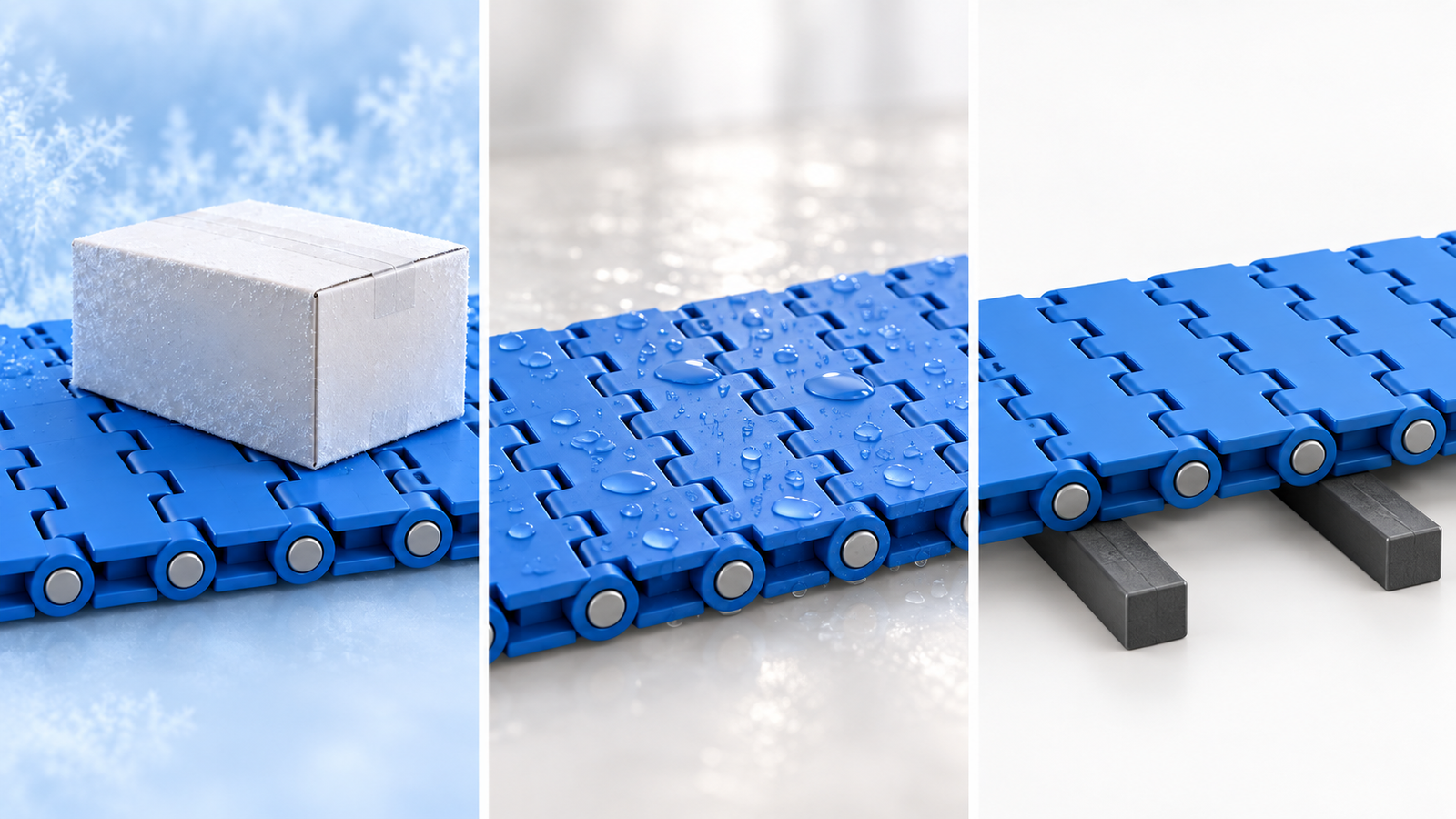
For a modular plastic conveyor belt, choose the material by the combination of mechanical demand, temperature, chemical exposure and contact conditions. PE is a candidate when flexibility and impact in a cold environment matter; PP warrants consideration for warmer or chemically demanding conditions; acetal can be useful where a hard surface and sliding contact matter. Those starting points need to be checked against the selected belt series and material grade.
This guide concerns belts assembled from plastic modules joined by pins or rods. A continuous rubber, PVC or polyurethane belt has a different construction and specification process. Even within modular belting, changing the resin does not identify the module geometry, hinge arrangement or matching sprocket.
Compare PP, PE and Acetal on the Same Dimensions
Strength, Stiffness and Impact
Strength is the ability to withstand a load without failure. Stiffness describes resistance to deformation under load. Impact resistance concerns a sudden blow. A hard, stiff surface is therefore not proof of good impact resistance, and a flexible material is not automatically suitable for the required belt pull.
ScanBelt’s standard-material descriptions provide useful qualitative starting points:
| Dimension | Polyethylene (PE) | Polypropylene (PP) | Acetal / Polyacetal (POM) |
|---|---|---|---|
| Mechanical character | Flexible, with strong impact resistance in the supplier’s description; verify pulling strength for the series | Harder material with good pulling force | Hard surface and strong pulling force; the standard material has lower impact resistance |
| Temperature direction | Candidate for cold-area use | Candidate for warmer applications | Check the grade’s operating range rather than infer it from surface hardness |
| Chemical exposure | Check the grade and actual chemical | Described as resistant to aggressive cleaning chemicals | Use caution with acid- or chlorine-containing cleaners |
| Sliding contact | Evaluate the actual contact pair | Evaluate the actual contact pair | Hard surface described as reducing friction against supports and products |
This is a summary of ScanBelt’s standard materials, not a universal ranking of every PE, PP or POM formulation. The impact description is particularly formulation-dependent: Habasit’s April 2021 guide, page 10, describes its standard POM as impact-resistant, while ScanBelt flags impact sensitivity for its standard acetal. A resin name does not settle that difference.
Habasit’s guide also cautions against high impacts on its PP in cold conditions and identifies PE as unsuitable for abrasive applications. Thus impact and abrasion must be compared separately: a material that tolerates a sudden load is not necessarily the one to choose for repeated sliding contact with grit. Both makers identify chemical conditions that limit their acetal materials. Belt geometry and grade-specific ratings are still needed to compare allowable pull and stiffness.
Temperature Environment and Cleaning Chemistry
The relevant temperature is what the belt experiences, including product contact, the surrounding area and cleaning. A belt may operate in a cold room but also encounter a warmer cleaning cycle. A material choice based only on normal room temperature can miss that second condition.
Chemical suitability is also more specific than the cleaner’s trade name. Identify its chemistry, working concentration, contact time and temperature. Intralox’s material-selection guide emphasizes application, environment and product, including the effect of changing cleaning chemistry. A previously acceptable process does not establish that a new formulation or concentration is acceptable.
Evaluate mechanical and environmental demands together. A material that meets a chemical condition still needs sufficient mechanical capability at the operating temperature. A room-temperature strength statement cannot establish the allowable belt pull throughout a different temperature cycle.
Read a Body-and-Pin Rating Together
The Habasit M2520 Flat Top data sheet (05.08.2026) shows how the combination changes the answer within one belt model. Its standard-material table has six body/connecting-rod combinations:
| M2520 belt body / connecting rod | Nominal straight-run tensile strength, N/m of belt width | Listed temperature range, °C |
|---|---|---|
| PE / PE | 9,000 | −70 to +65 |
| POM / PA | 32,000 | −40 to +93 |
| PA / PA | 28,000 | −40 to +130 |
| POM / PP | 21,500 | +5 to +93 |
| PP / POM | 18,000 | +5 to +93 |
| PP / PP | 18,000 | +5 to +105 |
The nominal ratings apply at 23°C. They describe longitudinal belt pull per meter of belt width, not the mass of products that may be loaded on the conveyor. In this table, changing a POM body’s rod from PA to PP changes both the nominal rating and the lower temperature bound. For the two PP bodies, the nominal rating stays the same but the upper temperature bound changes. Neither body resin nor nominal strength alone identifies the usable combination. These are Habasit’s M2520 values, not ratings for CSTRANS belts.
A Temperature Check Can Pass While Pull Fails
Suppose a 0.50 m-wide PE/PE belt is being considered and a separate design calculation has established a required total longitudinal pull of 4,000 N. Using M2520’s reference value gives 9,000 N/m × 0.50 m = 4,500 N. At first glance, that exceeds the required pull, and a drive-area temperature of 40°C also falls inside the listed −70 to +65°C range.
The required pull is 4,000 / 4,500 = 0.889 of the nominal total. Before any other applicable correction, a combined allowable-load factor below approximately 0.889 would leave less pull capacity than this assumed duty requires. For example, if the matching manufacturer data specified a factor of 0.60 for the actual conditions, the available pull would be 4,500 × 0.60 = 2,700 N. Here, 0.60 is an assumed teaching value, not a verified M2520 factor at 40°C.
The calculation identifies what must be checked: the current correction factors for the exact belt-body/rod combination, temperature and duty. Being inside the published temperature range alone does not establish sufficient allowable pull.
Which Application Variable Changes the Material Choice?
Cold Conditions With Impact
Consider a cold-area belt receiving products at a transfer. The decision involves both the environment and the way the load arrives. The impact-oriented candidate in the table deserves attention where products strike the modules, but the selection also needs to account for sustained belt pull and supported geometry. Choosing solely by surface hardness can overlook the abrupt loading at the transfer; choosing solely by impact resistance can overlook the load the complete belt must carry.
Product arrival is the useful variable here. A gently placed load and a dropped load impose different demands even when the product weight is identical. Record the transfer arrangement and the operating temperature at that point rather than treating all cold applications as equivalent. Also check for abrasive particles arriving with the product: an impact-oriented PE shortlist may need to change when grit repeatedly rubs across its surface.
Warmer Conditions With Wet Cleaning
For a warmer process that also sees cleaning chemicals, consider the warmer/chemical candidate in the table, then evaluate the cleaning cycle as a separate exposure. The useful comparison is between a grade’s documented limits and the combined operating and cleaning conditions.
A resin’s qualitative chemical resistance cannot authorize an arbitrary sanitizer concentration or hot wash. The trade-off is that solving one exposure may leave another constraint unresolved: chemical suitability does not prove hot-load capability, and temperature suitability does not prove compatibility with the actual cleaner. Product residue and moisture should be included where they affect the contact environment. Habasit’s 2021 general-material table, for example, distinguishes a +60°C wet-condition upper bound from +93°C in dry conditions for its POM. That distinction explains why “POM at this temperature” is incomplete. It does not replace the conditions for a selected current model or authorize a cleaning temperature.
Steady Movement With Sliding Contact
Where loading is gentle and the belt slides over supports, consider the sliding-contact candidate in the table. Then examine what it slides against. The support material, surface condition, debris and wet or dry operation form part of that contact pair. A generic low-friction description is not an installed friction measurement or a guaranteed reduction in drive power. Support friction contributes to the pull that the drive must transmit, while the material/rod combination determines available belt pull. If residue raises resistance at the supports, required pull can rise without any change to the product weight.
The trade-off changes if the same installation includes impacts at entry. A choice made for the support contact must still satisfy those intermittent loads. Similarly, a belt that moves products satisfactorily across one surface may interact differently with a sticky or abrasive product. Compare the actual product and support contacts instead of assigning a material one fixed friction behavior.
Keep Belt Body, Pins and Supports in the Comparison
Belt Material Does Not Identify Every Mating Part
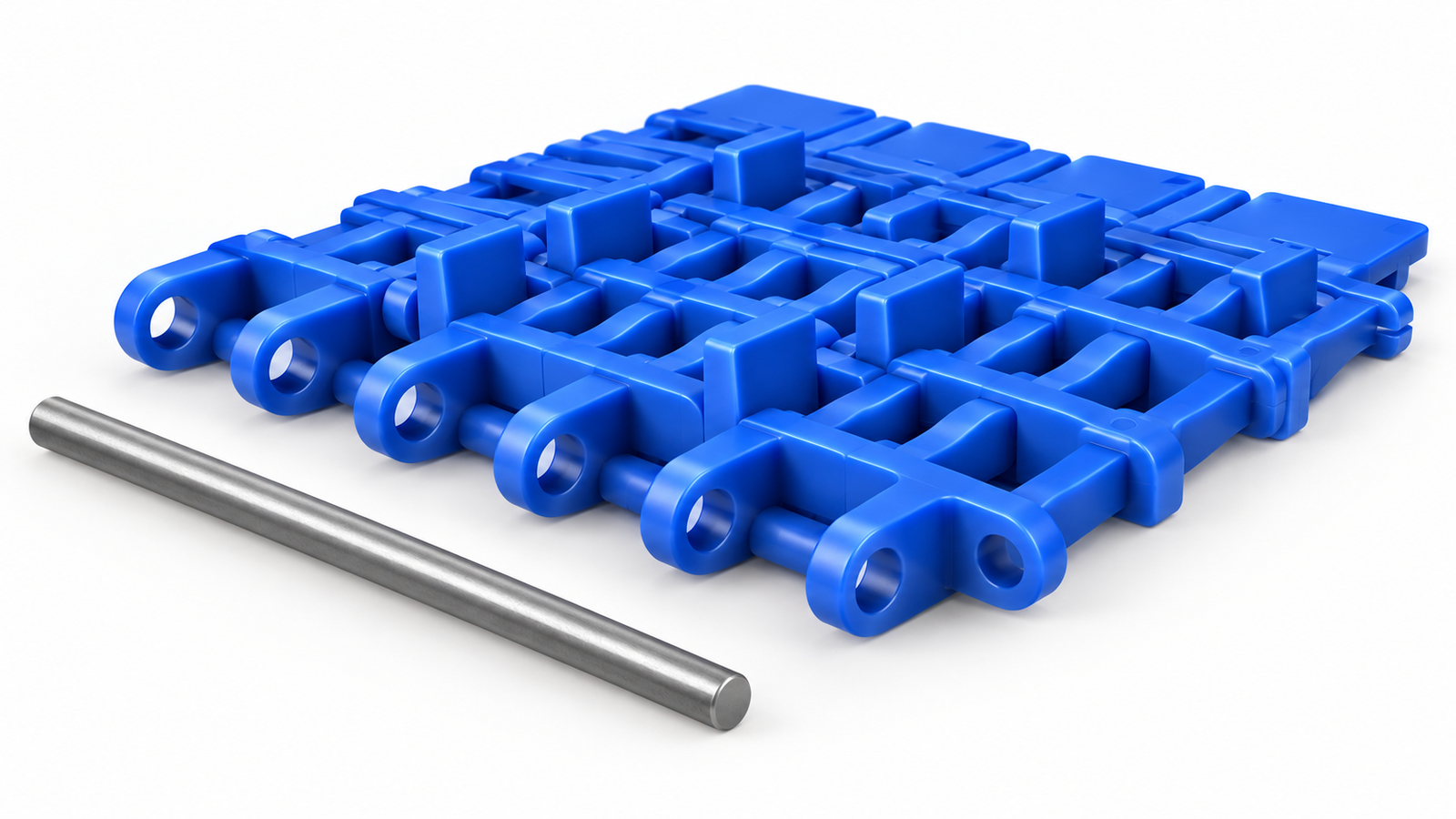
The modules form the belt body. Pins or rods connect adjacent hinge rows. Supports and wear surfaces carry the belt through its path. These parts perform different jobs and may use different materials, so the module resin does not establish the composition or chemical suitability of the complete assembly.
For a replacement, identify the body and pin specifications separately. A rod’s diameter, retention arrangement and material belong to the belt series; a similar-looking rod is not evidence of an interchangeable connection. The belt-support contact also needs its own review when the body material changes. A concrete CSTRANS example is the published 1270 product-page table: it lists POM/PP belt-body choices, POM/PP/PA6 pin choices and a 5 mm pin diameter separately. The shared pin diameter describes an interface dimension; it does not make the materials equivalent in pull, moisture or chemical behavior.
Confirm the Series and Grade After Narrowing the Choice
Use the comparison to form a shortlist, then obtain the current data for the actual series and grade. Check allowable belt pull under the relevant conditions, operating and cleaning exposures, module surface, pin specification and support recommendations. Any required product-contact compliance needs documentation for the selected material and intended use; the polymer name alone does not establish it.
Preserve the existing belt identity through this step. Series, pitch, width and module construction determine the matching drive interface. Sharing a resin name or pitch with another belt does not prove that its modules or sprockets are interchangeable. Color is useful identification information, but cannot establish resin composition.
Turn the Material Choice Into a Parts Request
For a plastic modular belt request, send the existing series or identifiable module photographs, width, quantity and the operating conditions that led to your material shortlist. Include the body and pin requirements separately. If the modular belt sprockets are also being replaced, supply their matching belt reference, tooth count and shaft interface. Use the component request form to have the selected parts and supply scope checked together.