
Select a plastic conveyor chain by its construction and exact series, conveyor route, required chain pull, operating conditions and mating parts. Check its allowable working load at the actual temperature, then match its sprockets, support and curve-retention features. Use the product load and its distribution, the chain, the route and friction to estimate the required chain pull.
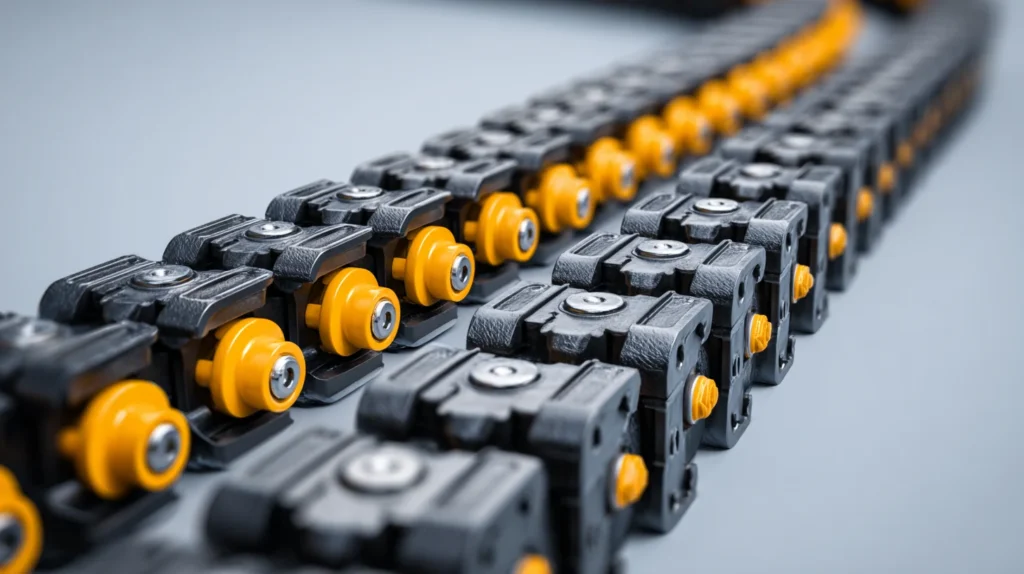
Identify the conveying-part family and route
Plastic tabletop chains have linked top plates and come in straight-running and side-flexing families. A chain in a flexible-chain conveyor must match the system’s beam, wear strips and bends. A plastic modular belt is assembled from module rows joined by rods to form its width.
These construction descriptions overlap with terms such as “slat” or “link”; performance is specified by the actual series. Straight-running and side-flexing describe route capability. Identify the actual construction and series before comparing allowable pull, material or replacement parts.
Choose the route family and the product-contact surface separately. A roller-top chain can be straight-running, such as CSTRANS 821-PRRS, or side-flexing, such as LBP 882TAB. Width is a third check: both the 820 and 821 straight-running ranges include a 190.5 mm option, but the 820 uses a single-hinge construction with a 4 mm plate, while the 821 uses a double hinge with a 4.8 mm plate. At that shared width, the hinge construction and plate thickness identify which family to match to the existing support and drive.
Record pitch, plate or belt width, joint and pin construction, underside tabs or other retention features, and any molded identification. Match the layout’s bend radius to the reference line on the selected model’s drawing. Check horizontal side flex separately from vertical return-path backflex. The straight-running versus side-flexing comparison explains the route distinction.
Select the material for temperature, chemicals and contact duty
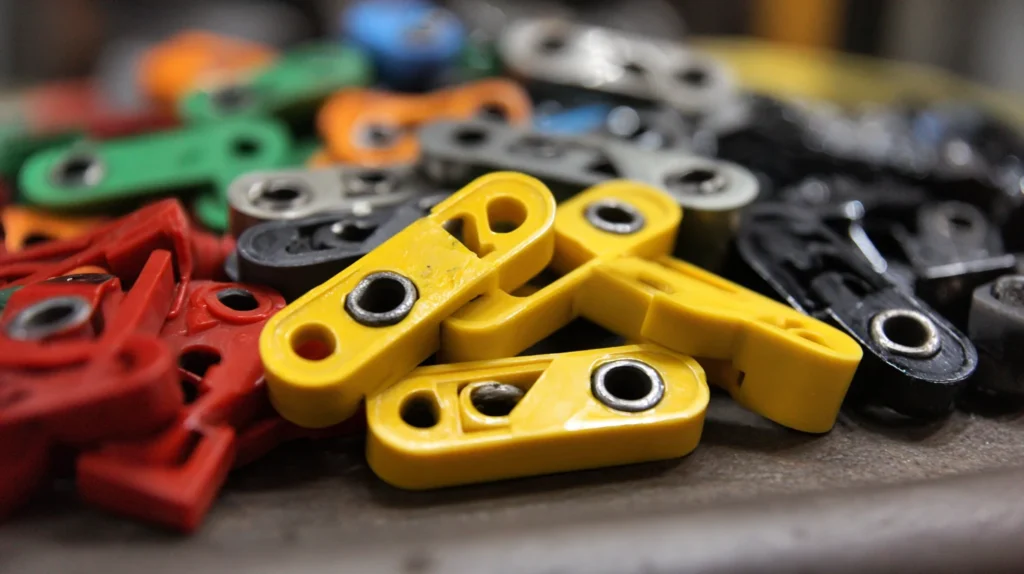
Acetal (POM), polyethylene (PE), polypropylene (PP), nylon (PA) and specialist polymers such as PVDF have different grade-dependent properties. Select from the materials offered for the required chain construction.
For sliding duty, compare the actual chain-and-support pair, load, speed, wet or dry running and contamination. For chemical exposure, record each substance, concentration, contact temperature and duration. Include cleaning cycles and the exposed pins, rollers and other components, as well as the plastic links.
Acetal’s low-friction properties can be useful in conveying applications, but allowable speed also depends on the series, supports, route and lubrication. Moisture response and temperature limits need the exact grade. For bakery equipment, measure the chain’s actual exposure and time at temperature.
Selection factors and the evidence to compare
| Key factor | What to establish | Material options to investigate | Application context and required check |
|---|---|---|---|
| Load capacity | Required chain pull and the selected chain’s allowable working load at operating temperature | Polypropylene; nylon, in the selected chain construction and grade | Automotive assembly; food processing. Include product load, route and support friction in the pull calculation. |
| Operating temperature | The chain’s actual exposure and the grade’s operating limits | Polyethylene; acetal | Bakery-oven or chemical-plant duty requires actual chain temperature, duration and wet or dry conditions. |
| Chemical resistance | Compatibility with each substance, concentration, temperature and contact time | Polypropylene; PVDF | Pharmaceutical production; waste treatment. Check the exact grade and all exposed chain components. |
| Wear resistance | Performance of the chain-and-support contact under the operating duty | Nylon; UHMWPE | Mining; packaging. Establish whether the material is used in the chain or its support, then include contamination, load and speed. |
| Food-contact eligibility | Documentation for the actual components and intended conditions of use | Polyethylene or nylon grades with applicable documentation | Beverage bottling; meat processing. Check the authorization, specifications and use conditions. |
Establish food-contact eligibility for the intended use
For a U.S. food-contact application, match the supplier’s documentation to the actual grade, formulation and intended contact conditions. Under the FDA food-contact framework, status depends on the constituent substances and applicable authorizations, including their specifications and use limits.
Ask for documentation identifying the supplied material and its applicable regulatory basis. Check the food type, contact time and temperature against the permitted conditions. When the basis is an effective Food Contact Substance Notification (FCN), check its identified manufacturer, substance and use. Keep the documentation with the selected part and application.
Compare required chain pull with allowable working load
Required chain pull is the tension the drive must transmit to move the chain and load through the conveyor. Allowable working load is the selected chain’s permitted operating tension under its stated conditions. Breaking strength is a different limit; use allowable working load for normal chain selection.
For the calculation, provide product mass and spacing, chain mass, carrying and return lengths, height changes, route, support friction, curves and accumulation. Include speed, starts and stops, wet or dry conditions and operating temperature. Product weight and distribution affect the required force; accumulated products can add sliding resistance even while they remain stationary above the moving chain.
Use the selected chain supplier’s calculation method and applicable duty factors for the whole route. Compare the calculated maximum pull with allowable working load at operating temperature. A chain that fits a curve geometrically must also meet the tension and sliding-contact requirements through that curve.
For example, 880TAB has a 2,100 N working-load reference at 21 °C. It has POM top plates, stainless steel pins and a 38.1 mm pitch. That force belongs to the tension check; use product mass as an input to the required-pull calculation. Keep the temperature condition with the rating when comparing the calculation.
Match sprockets, support and retaining features
Match the exact series to its specified sprocket profile, then check tooth count and shaft opening. The sprocket and gear guide explains why chain engagement differs from gear meshing.
For 880TAB, the underside tabs engage a retaining guide through the bend. Compare that track interface as well as plate width; record the underside tab-to-guide fit. Keep the support material, guide clearances and return arrangement with the chain selection, since replacing one component can affect its mating contact.
Plan maintenance around the actual environment
Temperature changes can alter dimensions and clearances. Washdown can change lubrication and expose plastics, pins and supports to cleaners. Dirt or hard particles in the running contact can accelerate wear. Keep these conditions in the selection record and inspect the locations where the duty is most demanding.
Follow the equipment’s inspection and maintenance plan. Before close inspection, follow the equipment’s hazardous-energy isolation procedure to prevent unexpected startup and control stored energy. Inspect chain links, pins, retaining features, sprocket engagement, wear strips and joints. Compare measured wear or elongation using the equipment’s specified measurement method and replacement limits. Lubricate only where the selected system’s instructions call for a compatible lubricant; a dry-running arrangement has different requirements.
Count pitch intervals between pin centers when recording elongation: ten intervals span eleven pin centers. For a 38.1 mm nominal pitch, ten intervals have a nominal length of 381 mm. An example measurement of 385 mm gives (385 − 381) ÷ 381 × 100 = 1.05% elongation. Counting only ten pin centers would give nine intervals and the wrong baseline. Keep the interval count, pin-center reference points and measurement conditions with each reading so that later results compare the same length.
Compare the selected chain grade and its mating support under the actual sliding conditions. Keep load, speed, temperature, lubrication and abrasive contamination with the comparison. Use the supplier’s data for that material pair when checking chain pull and wear.
Keep maintenance records by series, material, location and operating hours. Record changes in load, speed, cleaning and accumulation when comparing service intervals; otherwise a change in duty may be mistaken for a material improvement.
Compare price on a matched specification
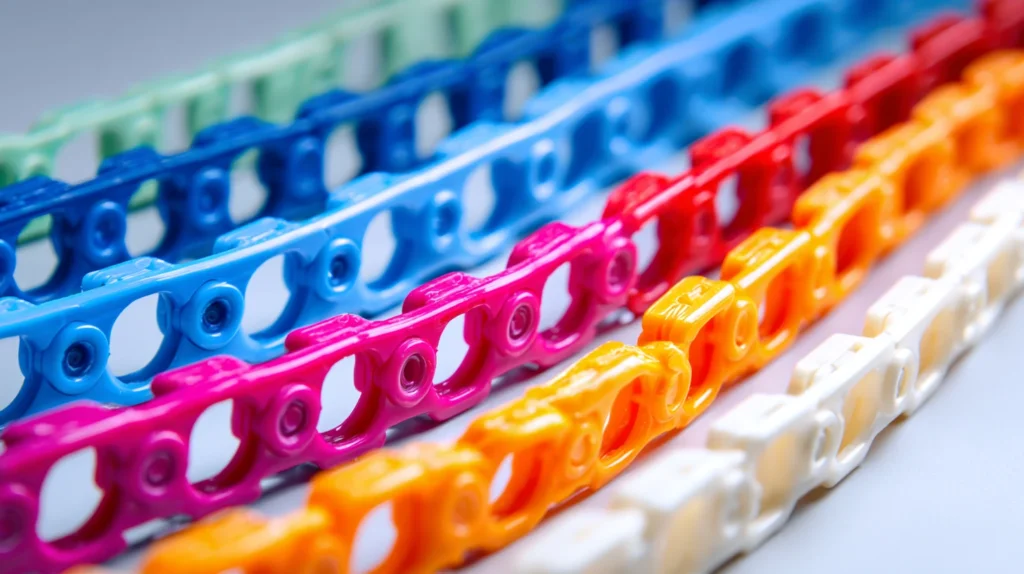
Request a quotation for the exact chain series, width, material grade, pin material and arrangement, length or link count, and quantity. Record the currency, quotation date, selling unit, included accessories, freight and delivery terms. Convert each offer to the same supplied-length and scope basis before comparing purchase and fitting costs.
Define the required function, quality and compatible components before comparing alternatives. Add purchase cost, fitting labor, any sprocket or guide changes, planned stoppage and the replacement interval observed under the relevant duty. Compare the complete installed and maintenance costs over the same production period.
Compare the width and curve of a selected series
880TAB-K325 is 82.6 mm wide with a 500 mm minimum side-flex radius. 880TAB-K450 is 114.3 mm wide; review its curve for the ordered configuration. Compare the retaining groove and underside tabs along with plate width.
Prepare the chain selection request
Send CSTRANS the existing chain identification or a drawing and photographs, required width and length, product load and spacing, speed, route and curve dimensions, accumulation, temperature and wet or dry conditions. Include sprocket and guide references, chemical exposure and required food-contact documentation. The conveyor-chain range is the starting point for matching that record to a component family.