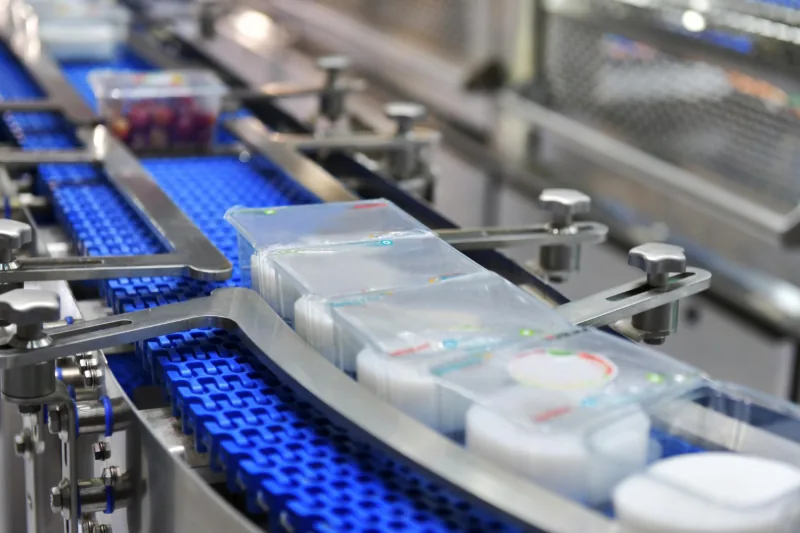
Unpackaged food, trays and sealed packs have different support and contact needs. Product residue and the cleaning cycle also affect component selection. For loose wet food, compare grid drainage with the smallest piece that must stay supported. A tray may ride on narrow feet, so compare their contact pattern with the openings. A flexible sealed pouch can sag into openings or catch its sealed edge at a transfer; compare a flat-top surface for continuous base support. The modular belt surface guide compares those carrying faces.
We supply chains, modular belts, sprockets, wear strips and guide components. Our technical support brings the part reference together with material, product-contact and cleaning requirements.
Residue, Cleaning and Transfers
Residue Around Hinges and Guides
Residue can collect around module hinges, pins, wear strips and guides. Belt openings, underside geometry and access to these areas affect cleaning.
Identify where residue remains and how the cleaning method reaches that area. The belt, rods and supports may use different materials, so the exposed combination needs to suit the cleaning conditions. Access and drainage also form part of the conveyor’s hygienic design.
Production and Cleaning Exposure
The conditions during production may differ from the conditions during cleaning. Cleaning temperature, chemicals, concentration, and exposure time can affect the material choice.
We check material requirements against both production and cleaning conditions. Specify the cleaning agent, concentration, temperature and exposure time. Food-contact documentation must correspond to the selected product and material.
Small or Fragile Products at a Transfer
A small product can lose support at a gap, while a fragile product may be affected by a change in conveying height or contact. A tray or sealed pack presents a different base to the same transfer.
Product size, stiffness and base contact determine the support needed through a transfer. Transfer gaps and height differences need to suit the product, tray or pack as well as the selected belt.
Food contact and cleaning exposure are separate material requirements.
Product, Material and Operating Requirements
Include the chain or belt series, width and material, together with the matching sprocket reference if needed. State whether the conveying surface touches unpackaged food, a tray or sealed packaging.
Confirm load, speed, operating temperature and any required food-contact evidence for the selected item. Material identity comes from the product specification and documentation.
Specify Your Food Conveyor Components
Our quotation identifies the selected components and material requirements. Include any required test documentation with the enquiry so it can be checked against the proposed items.